

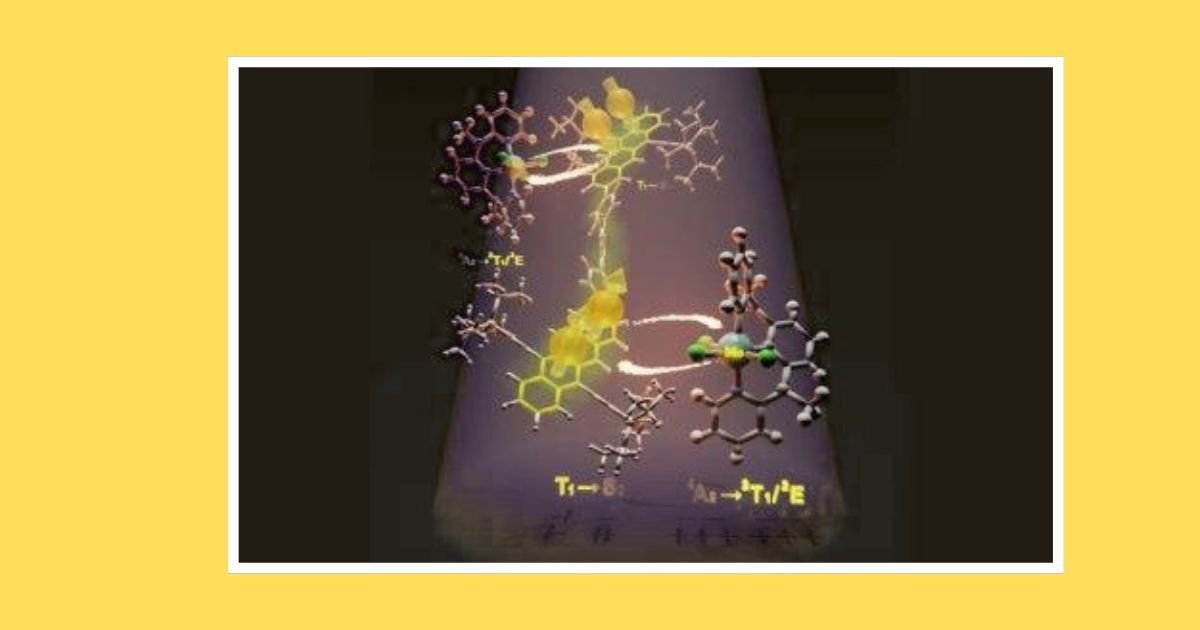
Tech News, Fukuoka (Japan), 30 March: Researchers from Kyushu University, in collaboration with Johannes Gutenberg University Mainz, have unveiled a molecular system that shatters the conventional efficiency barriers of solar energy. By utilizing a novel “spin-flip” molybdenum-based metal complex, the team demonstrated that a single photon can generate multiple energy carriers, achieving a quantum yield of 130%.
Traditional solar cells are constrained by the Shockley-Queisser limit, which dictates that they can only convert about one-third of sunlight into electricity. High-energy photons (like blue light) typically lose their excess energy as heat.
To overcome this, the research team employed a process known as Singlet Fission (SF). In this “dream technology,” a high-energy “singlet” exciton produced by a photon splits into two lower-energy “triplet” excitons, effectively doubling the potential energy output from a single particle of light.
The “Spin-Flip” Innovation
The primary hurdle in singlet fission has always been energy loss due to Förster Resonance Energy Transfer (FRET), where energy is “stolen” before it can be multiplied. The Kyushu team solved this by engineering a molybdenum-based metal complex with unique “spin-flip” properties:
The complex is designed to flip electron spins during light absorption, allowing it to selectively capture the multiplied triplet excitons while suppressing FRET.
More Read

In laboratory tests using tetracene-based materials in solution, the system activated approximately 1.3 metal complexes for every 1 photon absorbed.
The system successfully harvested more energy carriers than the number of incoming photons, surpassing the theoretical 100% limit for standard photovoltaics.
Future Outlook
While currently a proof-of-concept in a liquid solution, the team, led by Associate Professor Yoichi Sasaki, is now working to integrate these “spin-flip” materials into solid-state systems. This is the final step toward creating ultra-high-efficiency solar panels that could significantly outperform today’s commercial silicon cells. Beyond solar, the technology has immediate implications for next-generation LEDs and quantum information processing.