
New Delhi,, 20 June, 20026: For years, Elon Musk’s Neuralink has dominated headlines about brain chips and the future of human-computer interaction. Now, China is emerging as a serious competitor, raising questions about which country will lead one of the most revolutionary technologies of the century.
Brain-computer interfaces, often called BCIs, allow people to communicate with computers using brain signals. Scientists believe the technology could help restore movement to people with paralysis, allow patients to communicate after severe injuries, and potentially restore lost senses such as vision or hearing.
Until recently, the United States appeared to have a clear lead. Neuralink attracted worldwide attention after successfully implanting brain chips in human volunteers. Some participants can now move computer cursors and interact with digital devices using only their thoughts.
But China’s rapid advances have surprised many observers.
Recent reports suggest that Chinese researchers and technology companies have made significant progress in developing brain-computer interfaces and may have achieved certain commercial milestones before their American competitors.
One major difference between the approaches is safety.
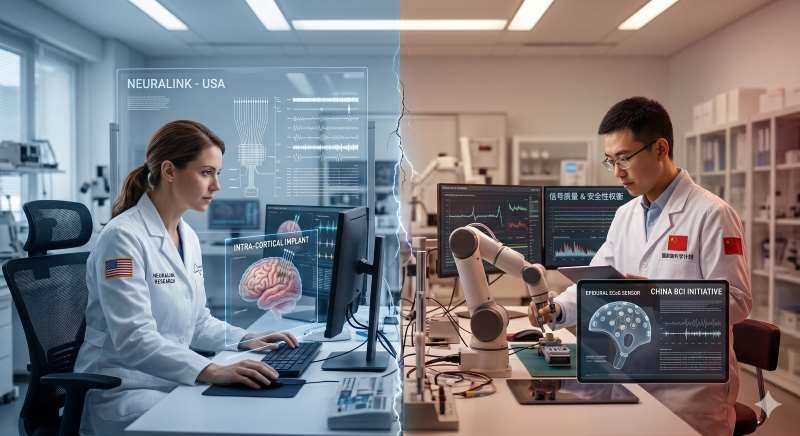
Neuralink uses tiny threads that are surgically inserted into the brain. This allows the device to receive highly detailed neural signals, giving users greater control and precision. However, because the system requires brain surgery, critics point to potential risks such as infection, bleeding, tissue damage, and the need for future surgical procedures.
Some Chinese brain-computer systems are taking a different path. Rather than penetrating the brain itself, they rely on external sensors or less invasive techniques to detect brain activity. Because these approaches avoid inserting electrodes directly into brain tissue, they may reduce surgical risks and be easier to deploy on a large scale.
The trade-off is performance. Signals detected outside the brain are generally weaker and less detailed than signals recorded directly from neurons. As a result, non-invasive systems may be safer but less capable, while implanted systems may be more powerful but involve greater medical risk.
Experts say it is still too early to declare a winner.
Neuralink currently attracts the most public attention and has demonstrated impressive capabilities in human patients. China, meanwhile, benefits from massive government investment, large-scale research programs, and a growing focus on advanced technologies such as artificial intelligence, robotics, and neuroscience.
The competition is increasingly being compared to the Space Race of the twentieth century. Instead of competing to reach the Moon, nations are now competing to connect the human brain to machines.
Supporters envision a future where people with paralysis regain independence, blind individuals recover some form of sight, and neurological diseases can be treated in entirely new ways.
Critics, however, warn that brain-computer interfaces raise profound ethical questions. Who owns the data generated by the brain? How can privacy be protected? Could future systems be hacked or misused?
Despite these concerns, momentum is building rapidly.
What began as a futuristic idea is becoming a real technology with real patients and real-world applications. Whether the future is led by Neuralink in the United States, China’s growing brain-chip industry, or a combination of both, one thing is becoming clear:
The race to connect minds and machines has already begun.