Australia Defines ‘National Interest’ Standards for Future AI Infrastructure

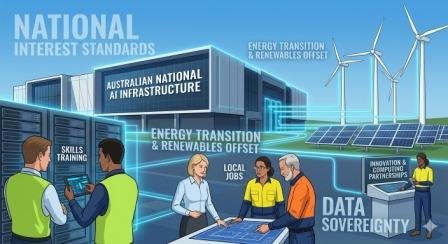
Tech News, Canberra, 23 March, 2026: The Australian Government has officially set a new benchmark for the digital age, releasing the National Data Centre Expectations. This framework, a key pillar of the National AI Plan, provides a roadmap for how data centers—the “engines” of AI—must operate to benefit the Australian public and economy.
Rather than a simple set of restrictions, the plan offers a regulatory “fast-track” for developers who meet high standards in energy, jobs, and innovation.
1. Energy: The “Bring Your Own Power” Model
To prevent the surge in AI demand from driving up household electricity bills, the government expects data centers to:
-
Underwrite Renewables: Fund or build new renewable generation and storage to offset their total energy consumption.
-
Grid Contribution: Pay the full cost of their grid connections, ensuring infrastructure upgrades aren’t subsidized by regular consumers.
-
Demand Response: Operate “flexibly” by reducing power use during peak times to help stabilize the national grid.
2. Workforce: Investing in Australian Skills
The government is moving away from facilities that simply house servers. New expectations require developers to:
-
Local Jobs: Create fair, secure, and well-paid roles for Australians.
-
Training Pipelines: Invest in local apprenticeships and specialized technical training to grow the domestic AI workforce.
3. Innovation: A “Social License” for Research
To ensure Australia isn’t just a “landlord” for foreign tech, the plan encourages:
-
Public Interest Compute: Hyperscalers are expected to provide high-performance computing access to Australian startups and researchers on favorable terms.
-
Domestic Partnerships: Collaboration with the local tech ecosystem to foster Australian-made AI solutions.
4. Sustainability: Water and Resources
Acknowledging the heavy water usage of AI cooling systems, the framework sets a preference for:
-
Recycled Water: Prioritizing non-potable or recycled water sources.
-
Cooling Innovation: Adopting “water-neutral” or highly efficient cooling technologies to protect local ecosystems.
Minister for Industry and Science Ed Husic noted that while these are “expectations,” they carry significant weight. The Commonwealth has committed to prioritizing the approval process for projects that demonstrate a clear alignment with these national interest standards.