
Tech News, Redmond, WA, 21 February, 2026 : Microsoft has announced a groundbreaking advancement in its Project Silica initiative, promising to revolutionize long-term data storage with an “affordable” solution capable of preserving information for an unprecedented 10,000 years on specialized glass plates. This breakthrough addresses the looming challenge of “data rot” and the increasing demand for ultra-durable archives in the digital age.
The core of Project Silica lies in its innovative use of five-dimensional (5D) optical data storage. Unlike traditional hard drives or magnetic tapes that degrade over time and require constant power or migration, glass plates etched with femtosecond lasers offer unparalleled resilience.
“We’ve reached a pivotal moment where we can not only etch vast amounts of data into quartz glass but do so in a way that is economically viable for cold storage,” stated a Microsoft spokesperson during a recent press briefing. “This isn’t just about extending lifespan; it’s about eliminating the need for energy to maintain the archive itself, drastically reducing the environmental footprint of long-term data preservation.”
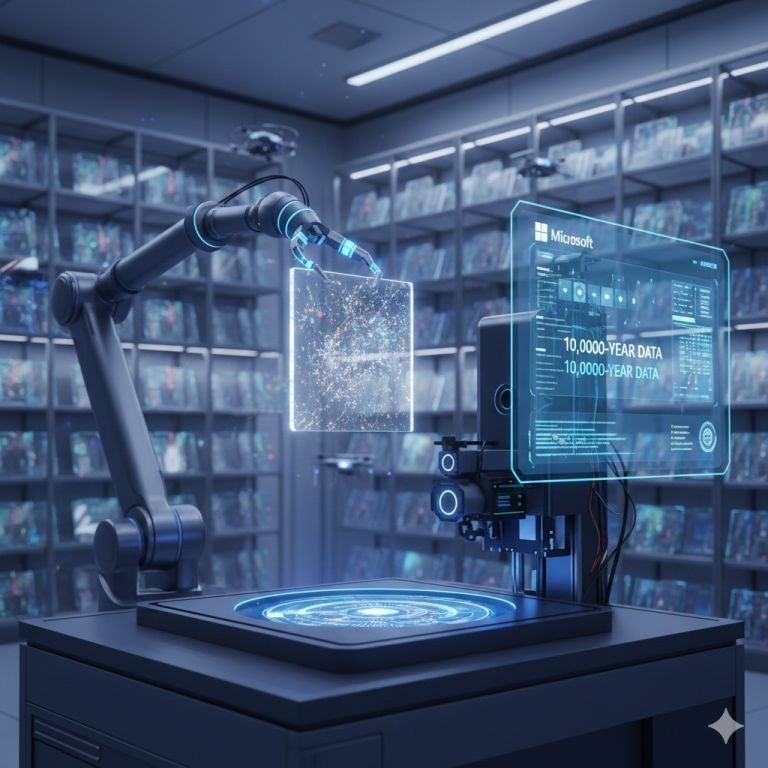
Recent advancements have focused on refining the process to achieve multi-terabyte capacity on a single, coaster-sized glass plate. The system utilizes ultra-fast laser pulses to create permanent, nanoscale structures called “voxels” within the glass, which store data based on their intensity, size, and orientation. Reading this intricate data is handled by computer-controlled microscopes and sophisticated Azure AI algorithms, which decode the complex optical patterns back into digital information.
Key Features of the Breakthrough:
More Read

10,000+ Year Lifespan: Data remains intact and readable for millennia, far surpassing any current storage medium.
Passive Storage: Once written, the glass plates require no power, cooling, or environmental controls, making them incredibly energy-efficient.
Extreme Durability: The quartz glass is virtually impervious to heat, water, electromagnetic pulses, and physical abrasions, ensuring data integrity under the harshest conditions.
Scalable Automation: Microsoft’s “Library” system leverages AI agents for automated retrieval and management of the glass plates, optimizing access for infrequently needed archival data.
This technology is poised to be a game-changer for institutions requiring immutable archives, such as historical records, scientific data, cultural heritage, and critical corporate information. By offering a true “write-once, read-many, store-forever” solution, Project Silica sets a new standard for data longevity, ensuring that humanity’s digital legacy can endure for generations to come.
“Imagine preserving the entire human genome, every significant scientific discovery, or a civilization’s artistic output for ten millennia without fear of decay,” the spokesperson added. “Project Silica makes that a tangible reality.”
The development underscores Microsoft’s ongoing commitment to sustainable and future-proof data solutions, laying the groundwork for a new era of digital preservation.