Udhamapur’s GI-tagged “Kaladi” to be upscaled for diverse food recipes using advanced food technologies: Dr. Jitendra Singh
Dr Jitendra Singh asks CSIR labs to leverage premier food technologies to expand culinary applications of Kaladi

Union Minister of State (Independent Charge) for Science & Technology and Earth Sciences, Dr. Jitendra Singh directed that “Kaladi”, the GI-tagged traditional dairy product of Udhampur district, Jammu & Kashmir, be upscaled for wider food applications and recipes, while strictly preserving its original flavour, texture, and nutritional identity.
The Minister said that the focus should be on value addition and enhancement of shelf life, enabling Kaladi to reach national and international markets under the Government’s “One District One Product” (ODOP) initiative.
Dr. Jitendra Singh emphasised that any scientific intervention must be carefully calibrated so that nutrition, taste, and native character are not compromised. He said that limited shelf life is the biggest constraint in expanding Kaladi beyond local markets and said that improving shelf life through scientific validation, proper packaging, and processing, without altering its core properties, is essential for marketability and export potential.
The Minister also highlighted the scope for food recipe diversification, including fresh consumption, functional forms and alternative culinary applications, provided the traditional milky flavour, mouthfeel, and stretchable texture of Kaladi are retained. He stressed that Kaladi’s uniqueness, often referred to as the “mozzarella of Jammu”, must remain intact even while exploring scalable formats.
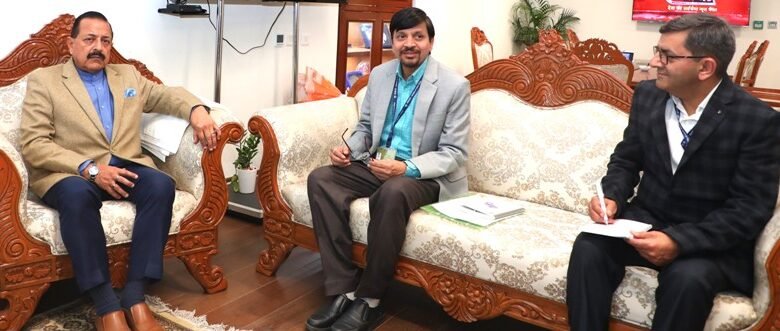
During the meeting, Dr. Jitendra Singh interacted with the Directors of CSIR-Central Food Technology Research Institute (CSIR-CFTRI), Mysuru, Dr. Giridhar Parvatam, and CSIR-Indian Institute of Integrative Medicine (CSIR-IIIM), Jammu, Dr. Zabeer Ahmed, and directed them to jointly work on nutrient profiling, characterisation, value addition, and shelf-life enhancement of Kaladi. The Minister asked the two premier CSIR laboratories to collaborate closely and provide initial observations within weeks, with a comprehensive outcome expected within six months.
It was noted that Kaladi, traditionally prepared from raw full-fat milk using whey water as a coagulant, has gained economic importance after receiving the GI tag, improving livelihoods and employment opportunities for local communities, particularly rural youth. However, its short shelf life of a few days, especially under non-refrigerated conditions, remains a major bottleneck for wider distribution.
Dr. Jitendra Singh said that the project will also involve documenting traditional methods followed in different regions of Jammu & Kashmir and scientifically identifying a common, industry-friendly process suitable for scale-up. Nutrient profiling and flavour validation will be integral to ensure consumer acceptance and regulatory validation.
The Minister further directed that technologies from India’s pioneering food technology institution, CSIR-CFTRI, Mysuru, one of the country’s most advanced and premier food research institutes, be leveraged for this initiative. He referred to CFTRI’s recent success where food technologies developed for millet-based products have been adopted by leading global food chains, and said that similar scientific approaches and options may be explored for Kaladi, wherever feasible.
Dr. Jitendra Singh said the initiative aligns with the Government’s vision of linking science, technology, and traditional products to strengthen local economies. He expressed confidence that once shelf life and value addition challenges are addressed, Kaladi can be promoted well beyond Jammu & Kashmir, fetching better returns for farmers and artisanal producers, while showcasing the richness of Dogra cuisine on national and global platforms.- PIB