
Tech News, 05 August, 2026, New Delhi: Brain-Computer Interface (BCI) technology has transitioned from controlled laboratory experiments into commercially viable, real-time medical applications. Driven by breakthroughs in generative artificial intelligence, high-bandwidth neural sensors, and bidirectional closed-loop architectures, modern BCI systems are actively restoring communication, mobility, and sensory perception to individuals living with severe paralysis, ALS, and spinal cord injuries.
Core Technological Innovations (2025–2026)
1. Zero-Latency Transformer Decoding
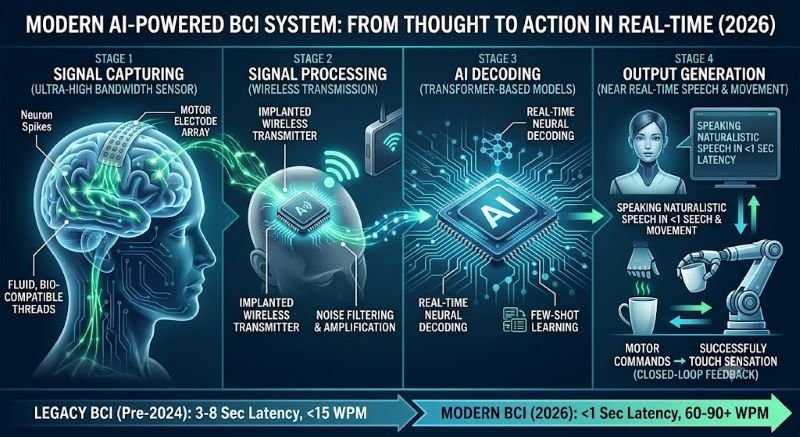
Earlier BCI platforms required weeks of calibration to map a user’s unique neural signatures. Current architectures utilize specialized Transformer-based neural networks capable of few-shot decoding. By recognizing intent within minutes of initial deployment, these models translate neural firing patterns into text or synthetic speech with an end-to-end latency below 50 milliseconds—enabling natural, fluid conversation without perceptible delay.
2. Bidirectional “Closed-Loop” Feedback
Communication is no longer one-way. While legacy systems focused purely on motor intent (Brain $\rightarrow$ Device), modern implants employ bidirectional closed-loop systems. When a patient controls a prosthetic limb to grasp an object, embedded sensors transmit electrical pulses back to the brain’s somatosensory cortex, restoring the physical sensation of touch and pressure to the user.
3. Non-Invasive Optical and Dry-Sensor Interfaces
While surgical implants like micro-electrode arrays remain the gold standard for fine motor control, non-invasive BCI hardware has advanced significantly. High-resolution functional Near-Infrared Spectroscopy (fNIRS) and flexible dry-electrode EEG headsets now capture sub-surface cortical activity with high signal-to-noise ratios, reducing the need for invasive neurosurgery in mild-to-moderate assistive care scenarios.
Comparative Assessment: Legacy BCI vs. Current Standard
| Technical Feature | Legacy BCI (Pre-2024) | Modern Standard (2026) |
| Decoding Latency | 3.0 to 8.0 seconds | Under 50 milliseconds |
| Speech Rate | 10–15 words per minute | 60–90+ words per minute |
| System Calibration | Days to weeks of daily training | Minutes via few-shot AI models |
| Communication Flow | Unidirectional (Brain to Machine) | Bidirectional (Brain $\leftrightarrow$ Sensory Feedback) |
| Surgical Form Factor | Wired / Bulkier transcutaneous links | Fully wireless, bio-compatible implants |
Medical & Commercial Trajectory
Regulatory Approvals: Leading regulatory bodies, including the U.S. FDA, have expanded human clinical trial clearances (such as Neuralink’s PRIME study and Synchron’s Stentrode trials) for broad rehabilitative use.
Inner Speech Reconstruction: Research led by Stanford University and UC Berkeley has successfully unlocked “inner speech” decoding—enabling non-verbal patients to generate complex text purely through thought, bypassing the need for physical vocal attempt.
Neuro-Privacy Standards: The rapid adoption of BCI has prompted international technology regulators to establish preliminary “Neuro-Privacy Frameworks” to protect mental data and prevent unauthorized neural telemetry tracking.
As ultra-low-power silicon chips, bio-compatible thread materials, and real-time AI models continue to mature, BCI technology is positioned to become a standard intervention in neuro-rehabilitation over the next decade. Beyond medical restoration, these systems set the foundational infrastructure for direct human-AI collaboration.