

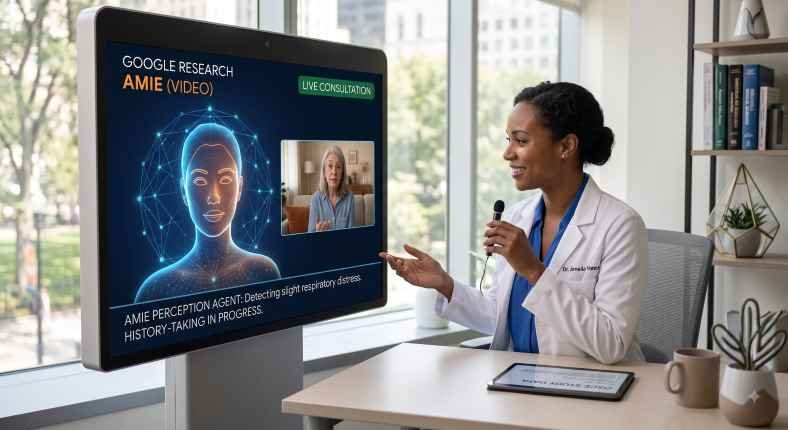
New Delhi:,13 August 2026: In a major milestone for healthcare technology, Google Research has announced significant advances in its medical AI system, AMIE (Articulate Medical Intelligence Explorer). The new video configuration, AMIE (Video), expands the system beyond text-based chat to conduct real-time, synchronous video consultations—demonstrating expert-level performance alongside board-certified primary care physicians.
Moving Beyond Text: Why Video Consultations Matter
When a physician meets a patient, diagnostic reasoning relies heavily on non-verbal visual and auditory cues. Doctors observe a patient’s posture, breathing pattern, visible distress, and guide them through physical examination maneuvers.
Traditional text-only AI models discard these essential dimensions, requiring patients to translate complex physical symptoms into written text. AMIE (Video) addresses this limitation by directly perceiving visual and auditory streams in real time.
How AMIE (Video) Works: The 3-Agent Architecture
Built on Google’s Gemini and Project Astra foundations, AMIE (Video) manages real-time audio-visual reasoning without conversational lag by deploying an asynchronous multi-agent architecture:
- Talker Agent: Manages patient-facing interaction, maintaining a natural conversational flow with low latency.
- Planner Agent: Operates in the background to refine clinical reasoning, update differential diagnoses, and map out treatment strategies.
- Perception Agent: Continuously analyzes the video and audio streams to detect non-verbal cues (such as physical discomfort or breathing variations) and contextually integrates them into the ongoing dialogue.
Key Results from the Randomized Study
To benchmark its capabilities, Google conducted a large-scale, randomized Objective Structured Clinical Examination (OSCE) study involving 100 clinical scenarios, 300 live consultations, and 15 professional patient actors. Performance was evaluated by an independent panel of 20 experienced primary care physicians against 30 board-certified PCPs.
- Expert-Level Accuracy: Evaluators rated AMIE (Video) on par with board-certified physicians across history-taking thoroughness, diagnostic accuracy, management appropriateness, and overall communication quality.
- Proactive Physical Examination: AMIE (Video) scored higher than both human PCPs and text-based AI in proactively guiding patient actors through virtual physical examination maneuvers.
- Patient Preference: Patient actors strongly preferred the video interface over text chat, highlighting higher ease of use, empathy, and confidence in care.
Future Direction & Limitations
Google noted that the current study was conducted with trained patient actors in simulated environments rather than real clinical settings. To validate utility and safety in real-world environments, Google has initiated early clinical feasibility studies in partnership with Beth Israel Deaconess Medical Center and Included Health.
Reference & Source Information
- Source: Officially published on the Google Research Blog.
- Original Article Title: Advancing AMIE towards expert-level audio-visual clinical consultations
- Publication Date: August 11, 2026
- Authors: Anil Palepu (Senior Research Scientist) and Mike Schaekermann (Research Lead, Google)
- Reference Link: Google Research Blog – Advancing AMIE