
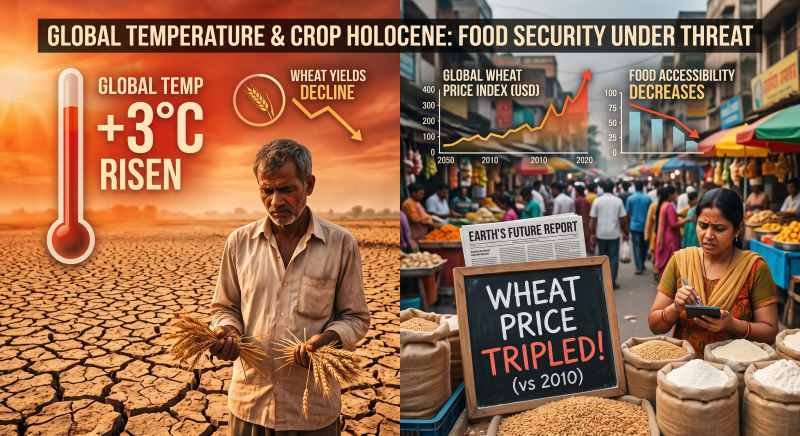
Tech News, 29 August 2026: A landmark study published in the peer-reviewed scientific journal Earth’s Future presents an urgent warning for global food security: a 3°C rise in global mean temperatures relative to pre-industrial baselines could cause average global wheat prices to triple compared to 2010 levels.
As extreme heat and erratic weather patterns destabilize traditional farming calendars, the findings underscore how atmospheric warming directly endangers staple grain production and threatens food affordability worldwide.
Why Wheat Is on the Climate Frontline
Wheat serves as a cornerstone of global human nutrition, supplying roughly one-fifth of total dietary calories and protein worldwide. Unlike heavily irrigated crops like rice, the vast majority of commercial wheat acreage is rain-fed, leaving yields exceptionally vulnerable to shifts in precipitation and soil moisture deficits.
Under a 3°C warming pathway, global agricultural systems face severe compounding stressors:
- Accelerated Evapotranspiration: Higher ambient temperatures exponentially increase the air’s vapor-pressure deficit. As established by the Clausius-Clapeyron relation—and demonstrated in foundational research by Held & Soden (2006)—saturation vapor pressure in the lower troposphere increases by ~7% per 1 K (or 1°C) rise, compounding to a ~20% surge under a 3°C scenario. This sharply accelerates moisture depletion from topsoil and plant canopies, leaving crop root zones desiccated.
- Thermal Shock During Grain-Filling: Heat stress during critical flowering and grain-filling stages impairs photosynthesis, shortens maturity windows, and results in shriveled kernels and lower total tonnage.
- Simultaneous Crop Failures: The probability of concurrent droughts across major “breadbasket” exporting nations (such as North America, Europe, Australia, and South Asia) escalates sharply, eliminating the market buffering typically provided by regional trade surpluses.
The Economic Fallout: From Parched Soils to Tripled Market Prices
The supply contraction resulting from yield declines triggers disproportionate market volatility. When staple yields fall below domestic consumption thresholds, export restrictions, emergency stockpiling, and market speculation drive rapid price inflation.
| Stage | Climate & Market Mechanism | Direct Impact |
| 1. Primary Trigger | +3°C Global Warming | Rising ambient temperatures expand atmospheric moisture capacity via the Clausius-Clapeyron relation. |
| 2. Environmental Stress | Rapid Soil Evaporation & Extreme Drought | Accelerated evapotranspiration and high vapor-pressure deficits strip moisture from root zones. |
| 3. Agricultural Consequence | Yield Declines Across Breadbaskets | Thermal shock during flowering/grain-filling and rain-fed water deficits cause widespread harvest failures. |
| 4. Economic Shock | Global Supply Deficit & Market Spikes | Multi-region production shortfalls prompt export bans, panic buying, and market speculation. |
| 5. Final Outcome | Wheat Prices Triple (vs. 2010 Levels) | Severe staple food inflation triggers affordability crises, heightened malnutrition, and socio-economic instability. |
For developing nations and import-dependent households where food purchases represent over 40–50% of monthly income, a three-fold price surge translates directly to heightened malnutrition, poverty spikes, and socioeconomic unrest.
Mitigating the Yield Deficit
Agronomists and climate policy analysts argue that preventing catastrophic food shortfalls requires immediate structural and agronomic interventions:
- Breeding Climate-Resilient Cultivars: Accelerating the rollout of heat, drought, and salinity-tolerant wheat varieties capable of withstanding abrupt thermal spikes.
- Adopting Regenerative Soil Practices: Scaling no-till farming, cover cropping, and organic mulching to maximize soil organic matter and preserve in-ground moisture.
- Precision Irrigation Infrastructure: Shifting from flood irrigation to solar-powered drip and micro-sprinkler systems to curb groundwater depletion.
- Crop Diversification: Expanding cultivation of drought-hardy, climate-smart alternative grains (such as millets and sorghum) to decentralize dietary reliance on single staple cereals.